
You have the Right to Repair
Find out what your state law guarantees — and what to do if a manufacturer refuses to comply.
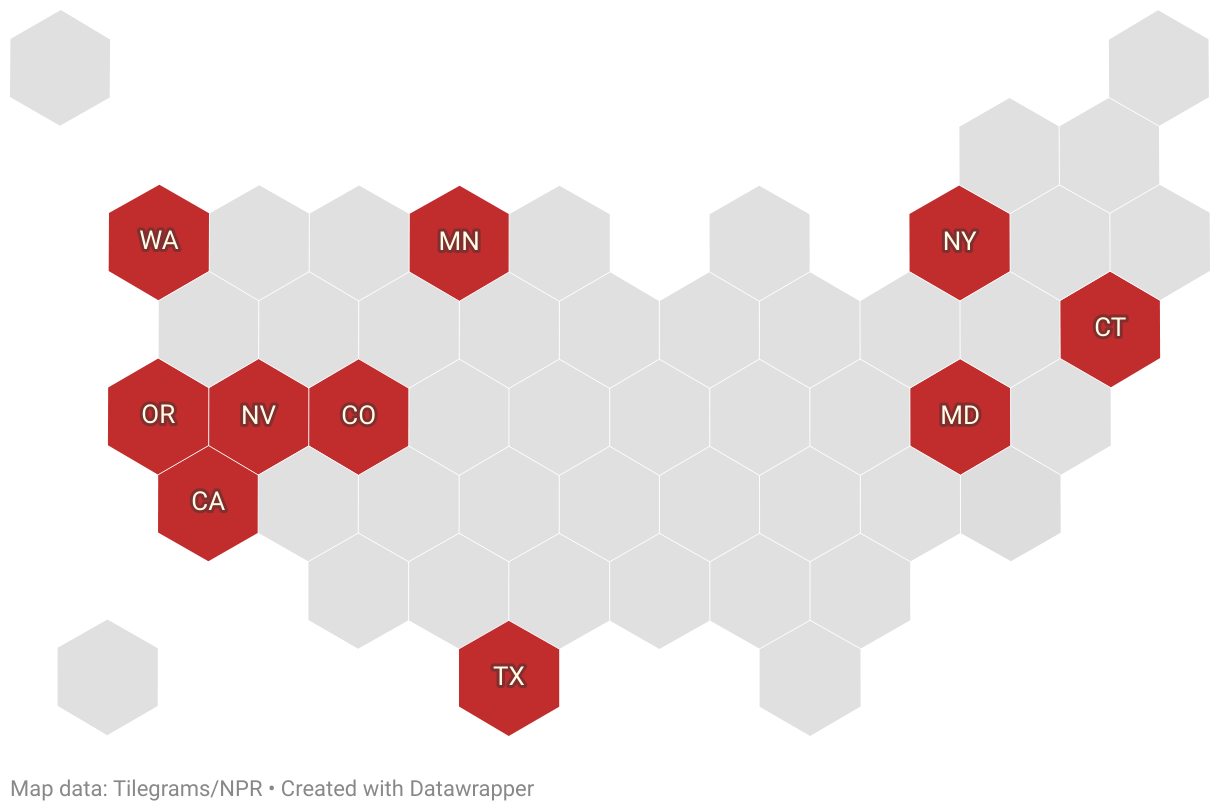
Check your repair rights by state
All state electronics Right to Repair laws that have passed so far ensure that you as an individual and/or a repair shop of your choice can get access to the same parts, tools, and documentation that manufacturers shops have. To exercise your repair rights, you don't have to fix your thing yourself. But the availability of parts, tools, and documentation should keep repair services competitively priced and widely available.
Spare Parts
Essential components available to fix any parts prone to wear or damage.
What These Laws Guarantee

Documentation
Comprehensive instructions for routine care, troubleshooting issues, and repairing a device’s components.
Hardware & Software Tools
Specialized tools to perform maintenance, diagnostics, and repairs.
Each law is a little different. Click your state above for exact details.
How to exercise your Right to Repair
1 Find your device’s release date
Find the release date of your device to determine if it is covered under your state’s law. Using your favorite search engine, enter the make and model of your device plus “release date.” Adding the model number to this search can be helpful. If you can’t find the release date through a search, reach out to the manufacturer directly.
Some manufacturers will have links to repair materials on their homepage, while others will not. In cases where there is not an easily accessible link, try using the search function on the manufacturer’s site or through your favorite search engine. When using a search engine, ensure that you are accessing the manufacturer’s website rather than a third-party link. If you are unable to find these resources directly from the manufacturer’s website, you can contact their support team and request the information you need.
NOTE: We love third-party repair, and encourage you to use it. In this case, we want to ensure that manufacturers are providing you with repair access required by law.
2 Ask the manufacturer
If you can’t easily find the parts, tools, or documentation you are looking for, contact the manufacturer’s customer service through the chat function, email address, or phone number listed on the manufacturer’s website. Explain to the customer service representative what device you have, what repair materials you are looking for, and that you would like access to those materials as required by law in your state. In addition to trying to access repair materials online, you can contact the manufacturer’s brick-and-mortar stores.
NOTE: It’s always best to be courteous with customer service representatives. However, don’t be afraid to be persistent if they say that self repair is not an option. Calmly explain that state law guarantees you access to repair materials for your device, and that you would like to get access to the parts, tools, or documentation you need as a result.
3 Document the response
Make sure to document any communications you have with manufacturer representatives. Take screenshots of chat conversations, save email threads, and take notes on phone calls. This will help you file a complaint with your state’s attorney general and the Federal Trade Commission.
NOTE: It can be illegal or unethical to record a phone call without the other party’s consent. As a result, we recommend taking notes rather than secretly recording any interactions with manufacturer representatives.
4 Report violations
While we hope that all covered manufacturers will comply with the laws from the start, there is no guarantee that they will do so. You have recourse options to right the situation if manufacturers fail to provide you with the repair materials you need. First, contact your state attorney general, who is usually in charge of enforcing state Right to Repair laws. Step-by-step instructions for each state with active legislation are below. After you’ve done that, be sure to also file a complaint with the Federal Trade Commission. While the FTC will not resolve individual cases, it can use the information provided to investigate and bring cases against manufacturers.
Report a Violation
If a company blocks your repair, here’s what to do
0 of 3 steps completed
Active Right to Repair Laws
-
Applies to products manufactured or sold on or after July 1, 2023.
Manufacturers must provide parts, tools, and documentation under the same terms they provide to their own authorized repair technicians.
Covers: consumer electronics.
Read Full Summary
-
2023: Powered Wheelchairs (Consumer Right to Repair Wheelchairs Act)
2024: Agricultural Equipment (Farm Equipment Right to Repair)
2026: Consumer Electronics & Appliances (Digital Equipment Act)
Read Full Summary
-
Applies to products manufactured or sold on or after July 1, 2021.
Manufacturers must provide parts, tools, and documentation to independent repair providers and product owners.
Covers: consumer electronics and household appliances.
Read Full Summary
-
Applies to products manufactured or sold on or after July 1, 2021.
Manufacturers must provide parts, tools, and documentation for 3 years (products ≤ $99.99) or 7 years (≥ $100).
Covers: consumer electronics and household appliances.
Read Full Summary
-
2025: Consumer Electronics & Appliances
2026: Powered Wheelchairs and Complex Rehabilitation Technology
-
Applies to products manufactured or sold on or after September 1, 2026.
Manufacturers must provide parts, tools, and documentation to independent repair providers and product owners.
Covers: consumer electronics retailing for more than $50.
Read Full Summary
-
Applies to products manufactured or sold on or after May 30, 2025.
Manufacturers must provide parts, tools, and documentation to independent repair providers and product owners.
Covers: powered wheelchairs.
Read Full Summary
-
Applies to products manufactured or sold on or after July 27, 2025.
Manufacturers must provide parts, tools, and documentation to independent repair providers and product owners.
Covers: digital electronic equipment.
Read Full Summary
-
Applies to products manufactured or sold on or after October 1, 2025.
Manufacturers must provide parts, tools, and documentation to independent repair providers and product owners.
Covers: powered wheelchairs.
Read Full Summary
-
Applies to products manufactured or sold on or after July 1, 2026.
Manufacturers must provide parts, tools, and documentation to independent repair providers and product owners.
Covers: Internet-connected home appliance, television or toy that includes a camera or microphone.
Read Full Summary
No law yet in your state?
You can help pass Right to Repair where you live. Every email and phone call matters.
-
Effective: July 1, 2024
Devices covered: The California Right to Repair Act, passed in 2023, applies to consumer devices that rely on microchips (any device “that depends for its functioning, in whole or in part, on any digital electronic embedded or attached to the product”) and household appliances (“any device primarily used for residential purposes, including, but not limited to, any refrigerator, freezer, microwave oven,” etc.) first manufactured, and sold or used in the state on or after July 1, 2021. This includes those devices that are sold to “schools, businesses, local governments, or in other methods outside of direct retail sale.” There are, however, some important caveats.
The device or appliance must have a wholesale value to the retailer of $50 or more.
The manufacturer must offer repair for the product through an authorized repair provider (either a branded store or a partner like Best Buy or uBreakiFix) or, if the manufacturer does not have an authorized repair provider, offer repair for the product itself (i.e. depot repair in which you ship your device to be fixed).
For manufacturers that offer repair services through both an authorized repair provider and depot repair, only the devices that are fixed by the authorized repair provider are covered. So, if you can get a phone made by manufacturer X fixed at their store, but you need to ship your tablet in to get it fixed, only the phone is covered under the law.
NOTE: The language of the CA Right to Repair Act is based on the Song-Beverly Act, a 1970 law that provided repair protections that predated the Right to Repair movement. That law requires that manufacturers of electronic devices and appliances with a wholesale value of $50 or more must “make available to service and repair facilities sufficient service literature and functional parts to effect the repair of a product” for a certain period of time that varies depending on the value of the device. You could argue that law requires manufacturers to at least provide authorized repair providers with all the repair materials needed to fix all covered devices. Have a test case? Let us know.
Devices NOT covered: California’s Right to Repair law does not apply to medical equipment, video game consoles; products and components of an alarm system; all-terrain vehicles or machinery used in functions such as farming, landscaping, ranching, and construction (see the definition of “equipment” in CA BPC 28-22901(j) for a full list). Refer to the above list of caveats to understand which consumer devices and household appliances are exempted from the law.
Additionally, California waives the repair requirement for any covered device or appliance if the manufacturer provides an equivalent or better, readily available product at no charge to the consumer.
What you can expect: For devices with a wholesale value to the retailer of $50-$99.99, manufacturers must provide the following for at least three years after the last date the product model or type was manufactured. For devices with a wholesale value to the retailer of $100 or more, manufacturers must provide the following for at least seven years after the last date the product model or type was manufactured.
Sufficient documentation (“product manual, diagram, reporting output, service code description, schematic, or similar information”) to effect the diagnosis, maintenance, or repair of a covered product. Documentation must be provided for free, unless you request it in a printed form, for which the manufacturer can charge the reasonable, actual cost to prepare and send the printed copy of the documentation. It also must be provided in the same “convenient and timely means of delivery” that the manufacturer provides to its authorized repair providers.
Sufficient functional parts to effect the diagnosis, maintenance, or repair of a covered product. Parts must be provided at costs and terms that are equivalent to the most favorable which the manufacturer provides to an authorized repair provider.
If a manufacturer does not use an authorized repair provider, parts must be provided at a price that reflects the actual cost to the manufacturer to prepare and deliver the part, not including any research and development costs.
Manufacturers are not required to sell parts if the parts are no longer provided by the manufacturer or made available to an authorized repair provider.
Sufficient tools (“any software program, hardware implement, or other apparatus”), including any updates, to effect the diagnosis, maintenance, or repair of a covered product. Tools must be provided for free, unless you request them in a physical form, for which the manufacturer can charge for the reasonable, actual cost to prepare and send the printed copy of the documentation. The tools must be provided in a way that does not restrict you from using them to restore your device to fully-functional condition and does not impair the “efficient and cost-effective performance” of the repair.
NOTE: Manufacturers are not required to provide documentation or tools that:
The manufacturer uses itself only to perform free diagnostic services over the phone, through online chat, or similar means that does not require the manufacturer to physically handle the device or appliance.
Are used exclusively for repairs that are completed by machines that operate on several devices or appliances simultaneously, provided the manufacturer makes available alternative documentation and tools to diagnose, maintain, and repair the device or appliance.
Would disable or override antitheft security measures set by the owner of the product, without the owner’s authorization.
Independent repair shops must provide written notice to the customer which states that a) the shop is not a manufacturer authorized repair provider, and b) disclosure if any used or aftermarket parts.
NOTE: Authorized repair ≠ better repair. Used and aftermarket parts can be cheaper alternatives to new, manufacturer parts.
Parts pairing: California’s Right to Repair law does not ban parts pairing. It does, however, require manufacturers to provide sufficient software tools and documentation to restore your device or appliance to fully functional condition. That means you must be able to pair your parts to your device or appliance, and you must be able to do so for free.
For independent repair shops: Shops that are not authorized by the manufacturer must provide written notice to consumers seeking repair that a) informs the consumer that it is not an authorized repair provider and b) disclose if it uses any used or aftermarket parts in the course of repair.
-
The state of Colorado is leading the way on Right to Repair. Over the past three years, the state has passed laws guaranteeing access to repair materials for owners of wheelchairs, farm equipment, consumer devices, home appliances, and enterprise equipment.
Effective date: January 1, 2026
Devices covered: Colorado’s latest Right to Repair law, passed in 2024, guarantees access to repair materials for devices first manufactured, used, and sold in the state on or after July 1, 2021 that depend “in whole or in part, on digital electronics embedded in or attached to the product in order for the product to function as intended.” That includes consumer devices (e.g. smartphones, laptops, tablets, TVs, digital cameras), home appliances (e.g. smart refrigerators, washing machines, ovens), and enterprise equipment (e.g. servers, networking equipment, power infrastructure, cooling infrastructure) used by businesses, schools, and governments.
Devices NOT covered: The law does not apply to non-wheelchair medical equipment, video game consoles, power tools, cars, electric vehicle charging equipment, marine vessels or recreational vehicles, energy storage or power generation equipment such as generators, and fire alarm systems.
Additionally, Colorado waives the repair requirement for cable boxes, modems, and routers if your video, internet, or voice service provider offers an equivalent or better, readily available product at no charge to the consumer.
What you can expect:
Any repair documentation (manuals, schematic diagrams, reporting outputs, service code descriptions, security code or passwords, or similar guidance or information) that a manufacturer provides to an authorized repair provider. These materials must be provided to you on costs and terms that are equivalent to the most favorable costs and terms that the manufacturer offers to an authorized repair provider.
Any new or used replacement part that a manufacturer offers for sale or makes available for the purposes of repair. This includes any component parts that are provided to a manufacturer’s depot repair facility, but typically not board-level components. These parts must be made available at costs that are fair to both parties and on terms (such as delivery times) that are equivalent to those provided to authorized repair providers.
Any softwaretool used for diagnosis, maintenance, or repair of digital equipment. Software tools must enable you to return your device to fully-functioning condition, and be provided at no charge in a manner that does not prevent you from using your device in an efficient and cost-effective manner.
Any physical tool used for diagnosis, maintenance, or repair of digital equipment to return it to its full functionality. The manufacturer may include a charge for the reasonable, actual cost of preparing and sending the tool to the owner or independent repair provider.
Parts pairing: Devices that are manufactured for the first time and sold or used in Colorado after January 1, 2026 cannot be designed such that parts pairing can prevent you from restoring your device to a fully-functioning state. If you use an aftermarket or used part, any misleading alerts or warnings about unidentified parts must be immediately dismissable.
While parts pairing can be used in devices first manufactured, sold, and used in Colorado between July 1, 2024 and January 1, 2026, the manufacturer must provide you with any tool or information required to pair or activate the part yourself.
-
Effective date: January 1, 2024
Equipment covered: The Consumer Right to Repair Agricultural Equipment Act, passed into law in 2023, guarantees access to repair materials for “equipment used to plant, cultivate, or harvest agricultural products or ranch.” That includes tractors, trailers, combines, sprayers, tillage implements, balers, and more.
Equipment NOT covered: The law does not apply to cars, powersports vehicles, aircrafts, or equipment designed and used primarily for irrigation purposes.
What you can expect:
Any repair documentation (manuals, schematic diagrams, reporting outputs, service code descriptions, security code or passwords, or similar guidance or information) that a manufacturer provides to an authorized repair provider for the purposes of diagnosis, repair, and maintenance. Documentation must be provided at no cost, unless you request it in a printed form, for which the manufacturer can charge for the actual fee to prepare and send the printed copy of the documentation.
Any new or used replacement part that is intended for use with your equipment. These parts must be made available at costs that are fair to both parties and on terms (such as delivery times) that are equivalent to those provided to authorized repair providers.
Any software tool used for diagnosis, maintenance, or repair of digital equipment. Software tools must enable you to return your device to fully-functioning condition, and be provided at no charge in a manner that does not prevent you from using your device in an efficient and cost-effective manner.
Any physical tool used for diagnosis, maintenance, or repair of digital equipment to return it to its full functionality. Physical tools must be provided on terms that are equivalent to those provided to authorized repair providers and at costs that are no greater than the manufacturer’s suggested retail price.
Parts pairing: Manufacturers cannot require that a part, embedded software, firmware, or tool be registered, paired with, or approved by the manufacturer or an authorized repair provider before being operational.
-
Effective date: January 1, 2023
Devices covered: The Colorado Consumer Right to Repair Wheelchairs Act, passed in 2022, guarantees access to repair materials for “motorized wheeled device[s] designed for use by a person with a physical disability.”
Devices NOT covered: Other take-home medical equipment is not covered by the bill.
What you can expect:
Any repair documentation (manuals, schematic diagrams, reporting outputs, service code descriptions, security code or passwords, or similar guidance or information) that a manufacturer provides to an authorized repair provider for the purposes of diagnosis, repair, and maintenance. Documentation must be provided at no cost, unless you request it in a printed form, for which the manufacturer can charge for the actual fee to prepare and send the printed copy of the documentation.
Any new or used replacement part that a manufacturer offers for sale or makes available for the purposes of repair. This includes any component parts that are provided to a manufacturer’s depot repair facility, but typically not board-level components. These parts must be made available at costs that are fair to both parties and on terms (such as delivery times) that are equivalent to those provided to authorized repair providers.
Any softwaretool used for diagnosis, maintenance, or repair of digital equipment. Software tools must enable you to return your device to fully-functioning condition, and be provided at no charge in a manner that does not prevent you from using your device in an efficient and cost-effective manner.
Any physical tool used for diagnosis, maintenance, or repair of digital equipment to return it to its full functionality. The manufacturer may include a charge for the reasonable, actual cost of preparing and sending the tool to the owner or independent repair provider.
-
Effective: July 1, 2024
Devices covered: The Minnesota Digital Fair Repair Act (Sec. 11, starting at 167.8), passed in 2023, applies to any hardware product sold on or after July 1, 2021 that relies on a microchip (any device that “depends, in whole or in part, on digital electronics embedded in or attached to the product in order for the product to function”). That includes consumer devices (e.g. smartphones, laptops, tablets, TVs, digital cameras, e-bikes), home appliances (e.g. smart refrigerators, washing machines, ovens), and enterprise equipment (e.g. servers, networking equipment, power infrastructure, cooling infrastructure) used by businesses, schools, and governments. There are, however, some important caveats.
The manufacturer must offer repair for the product through an authorized repair provider (either a branded store or a partner like Best Buy or uBreakiFix) or, if the manufacturer does not have an authorized repair provider, offer repair for the product itself (i.e. depot repair in which you ship your device to be fixed).
For manufacturers that offer repair services through both an authorized repair provider and depot repair, only the devices that are fixed by the authorized repair provider are covered. So, if you can get a phone made by manufacturer X fixed at their store, but you need to ship your tablet in to get it fixed, only the phone is covered under the law.
Devices NOT covered: Motor vehicles, medical devices, off-road or nonroad equipment (farm equipment, industrial equipment, outdoor power equipment, recreational vehicles, portable generators, boats, etc.), video game consoles, power tools, and energy storage system are some examples of equipment types that are exempted from the law. Special cybersecurity tools provided to national defense organizations like the NSA are also exempted, as are repair materials that are used in work that is required to be done or supervised by a licensed individual or contractor under Chapter 326B.
Additionally, Minnesota waives the repair requirement for any covered device or applianceif the manufacturer provides an equivalent or better, readily available product at no charge to the consumer.
What you can expect: Within 60 days after the first sale of the device, manufacturers must provide the below repair materials.
Documentation (“a manual, diagram, reporting output, service code description, schematic diagram, or similar information”) that a manufacturer makes available to an authorized repair provider to diagnose, maintain, or repair covered equipment. If a manufacturer does not have an authorized repair provider but offers diagnostic, maintenance, or repair services, it must provide the documentation it uses for those services. Documentation must be made available at no charge, unless it is requested in a physical printed farm, for which the manufacturer can charge the reasonable actual costs of preparing and sending the copy.
New or used replacement parts (“any replacement parts or assembly of parts”) that a manufacturer makes available to an authorized repair provider to diagnose, maintain, or repair covered equipment. If a manufacturer does not have an authorized repair provider but offers diagnostic, maintenance, or repair services, it must provide the parts it uses for those services. Parts must be provided at costs that are fair to both parties.
Manufacturers are NOT required to sell parts that are no longer provided by the manufacturer or made available to authorized repair providers of the manufacturer.
Any tools (“any software program, hardware implement, or other apparatus used for diagnosis, maintenance, or repair”) needed to restore your covered device back to fully-functional condition. Manufacturers must provide these tools at costs that are equivalent to the lowest actual cost that the manufacturers offer to an authorized repair provider.
Manufacturers must offer documentation, parts, and tools on terms that are equivalent to the most favorable terms that they offer to an authorized repair provider, including the method and timeliness of delivery. Those terms cannot obligate you to use the repair materials or restrict your use of the repair materials. A manufacturer cannot require you to become an authorized repair provider before getting access to repair materials.
Manufacturers are NOT required to make available documentation, parts, or tools:
For the purposes of modification of a covered device.
That are specially designed to disable or override antitheft security measures set by the owner of the equipment, without the owner’s authorization.
Parts pairing: Manufacturers cannot impose a requirement that a part be registered, paired with, or approved by the manufacturer before the part is operational.
-
New York’s Fair Repair act was the first Right to Repair law in the country to cover electronics. While much was made about the limiting amendments Gov. Kathy Hochul made before signing it into law, the law still provides significant repair rights to consumers and independent repair providers in New York.
Effective: March 3, 2024
Devices covered: The New York Fair Repair Act, passed in 2022 and signed into law in 2023, covers any hardware product with that was first manufactured, sold and used on or after July 1, 2023 that relies on microchips (“depends on its functioning, in whole or in part, on digital electronics embedded in or attached to the product”) that is sold to consumers via a retail seller. That includes consumer devices such as smartphones, laptops, tablets, TVs, gaming consoles, digital cameras, wireless speakers, and many headphones. There are, however, some important caveats.
The device must have a value of $10 in 2023 dollars. (You can use an inflation calculation tool to determine if your product meets this threshhold.)
The manufacturer must offer repair for the product through an authorized repair provider (either a branded store or a partner like Best Buy or uBreakiFix) or offer repair for the product itself (i.e. depot repair in which you ship your device to be fixed).
Devices NOT covered: Hardware products sold business-to-government or business-to-business that are not otherwise offered for sale directly to consumers via retail sale, motor vehicles, medical devices, public safety communications equipment, home appliances, farm equipment, construction equipment. Turf and garden equipment, outdoor power equipment, marine and recreational vehicles, commercial and industrial electrical equipment (e.g. transformers, remote power panels), and e-bikes are examples of equipment not covered by the law.
What you can expect:
Any documentation (“any manual, diagram, reporting output, service code description, schematic diagram, or similar kinds of information”) required to service, maintain, or repair covered devices. Documentation must be made available at no charge, unless it is requested in a physical printed farm, for which the manufacturer can charge the reasonable actual costs of preparing and sending the copy.
Any new or used part (“any replacement part or assembly of parts”) made available by a manufacturer to service, maintain a covered device. Parts can be made available either by the manufacturer themselves or an authorized provider. Parts must be provided at “reasonable” costs and terms, meaning that manufacturers cannot impose a substantial obligation or restriction that is not reasonably necessary to engage in repair services, require a consumer or independent repair shop to become an authorized repair provider,
Manufacturers or their authorized providers are not required to provide printed board assemblies that may allow illegal device cloning are not included in the law.
Any tools (“any software program, hardware implement, or other apparatus”) used to diagnose, service, or repair covered devices. Tools must be made available at no charge and without requiring authorization for use or operation of the tool. When a tool is requested in physical form, a charge may be included for the reasonable, actual costs of procuring, preparing and sending the tool.
Manufacturers and their authorized providers must provide documentation, parts, and tools in a manner that does NOT condition or impose a substantial obligation or restriction that is not reasonably reasonable necessary for a consumer or independent repair shop to effect the diagnosis, maintenance, or repair of a covered device.
Parts pairing: Manufacturers or their authorized providers must provide tools that program, pair a part, calibrate functionality, or perform any other part back to fully functional condition.
For independent repair shops: Before signing the bill into law, the governor added language that manufacturers are allowed to establish reasonable training and certification programs for independent repair providers. OEMs cannot, however, require independent repairers to complete such training and certification to access repair materials as required by the law.
-
Effective: January 1, 2025 (PENDING)
Devices covered: The Oregon Right to Repair Consumer Electronic Equipment Act, passed in 2024, covers hardware (“is tangible personal property”) that has a microchip (“functions, in whole or in part, on the basis of digital electronics that are embedded within or attached to the product”), that is “generally used for personal, family, or household purposes.” That includes consumer devices such as smartphones, laptops, tablets, TVs, gaming consoles, digital cameras, wireless speakers, and many headphones.
Devices NOT covered: Motor vehicles, products that have never been available for retail sale to a consumer (i.e. enterprise equipment), medical devices, heaters, ventilation systems, air conditioners, refrigerators, solar systems and batteries, video game consoles, electric utility devices, recreational vehicles, boats, off-road equipment (e.g. farm equipment, outdoor power equipment, garden and turf equipment), and electric toothbrushes are not included in the law.
What you can expect: For devices that are used or supplied in Oregon one year or more after the product was first manufactured or sold and used in the state, manufacturers must provide the following.
Any documentation (“any manual, diagram, reporting output, service code description, schematic diagram, security code, password or other guidance or information”) used to diagnose, maintain, repair, or update covered equipment. Documentation must be made available at no charge, unless it is requested in a physical printed farm, for which the manufacturer can charge the reasonable actual costs of preparing and sending the copy.
Any new or used part (“replacement component”) made available by a manufacturer to maintain, repair, or update a covered device. Parts must be made available directly to the consumer or through an authorized provider at costs and terms that are equivalent to the most favorable costs and terms at which the manufacturer offers the parts to an authorized service provider, including convenient means of delivery.
Any tool (“software, a hardware implement or an apparatus…including any software, or a mechanism that provisions, programs or pairs, a new part, calibrates functionality or performs another function”) that is necessary to update or restore a product to fully functional condition. Tools must be provided at no charge and without impeding “access to the tools or the efficient and cost-effective use of the tools,” except in the case of physical tools, for which manufacturers can charge for reasonable and actual costs of preparing and shipping that tool.
Manufacturers must offer documentation, parts, and tools on terms that are equivalent to the most favorable terms that they offer to an authorized repair provider, including the method and timeliness of delivery. Those terms cannot obligate you to use the repair materials or restrict your use of the repair materials. A manufacturer cannot require you to become an authorized repair provider before getting access to repair materials.
Parts pairing: Manufacturers cannot use parts pairing (the “practice of using software to identify component parts through a unique identifier”) to a) prevent you from installing or enabling the function of a replacement part, including aftermarket parts, b) reduce the functionality or performance of covered devices, or c) cause your device to display misleading alerts or warnings about unidentified parts that you cannot immediately dismiss.